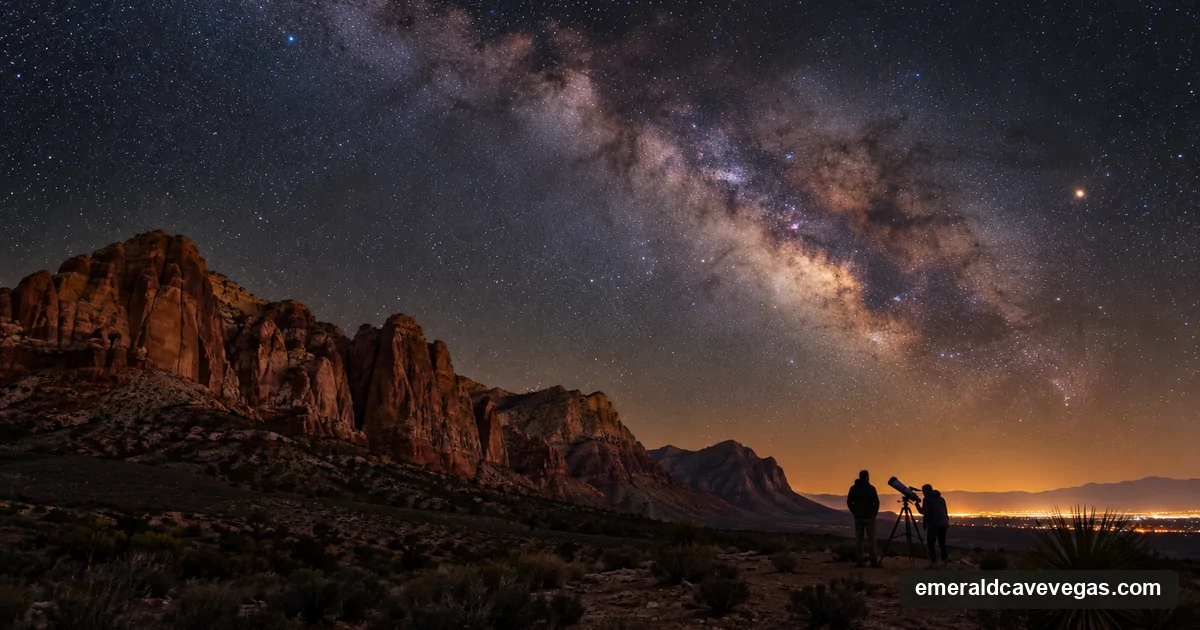
Here's the honest truth: you can't stargaze in Las Vegas — it's one of the brightest night skies on Earth. Stargazing here means doing the same thing that takes you down to the Black Canyon by kayak — escaping the Strip for a natural wonder. This is where the dark skies actually are, the tours worth booking, when to go, and how Vegas stacks up against the real dark-sky destinations.
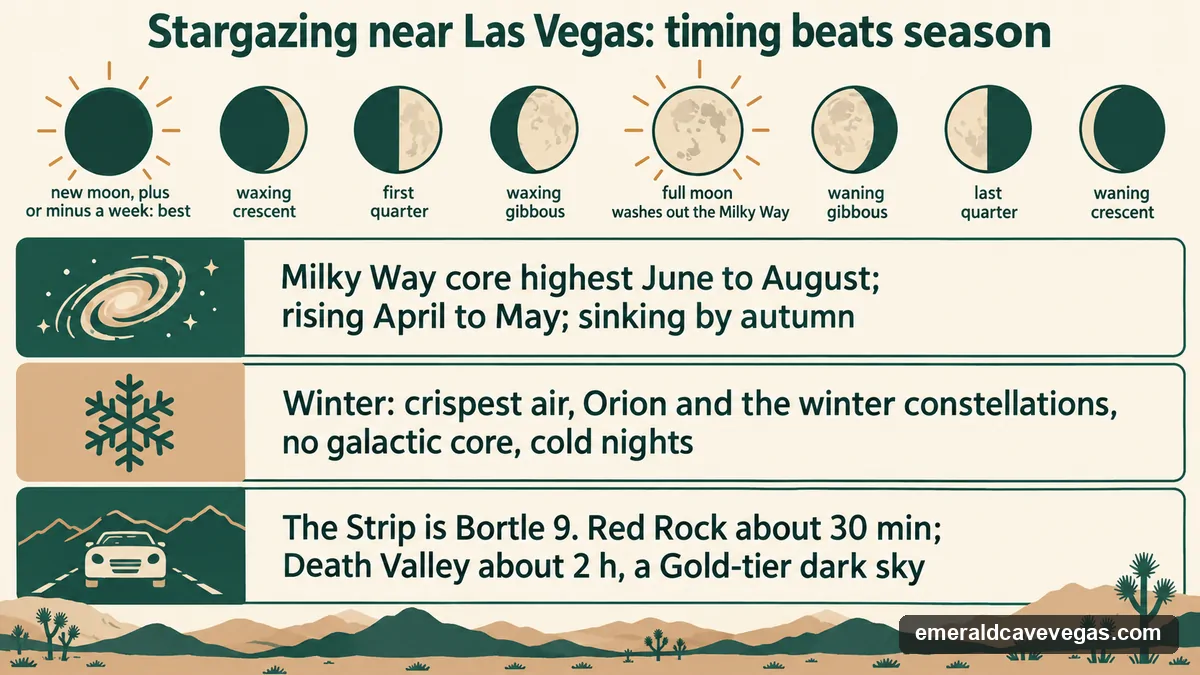
Stargazing in Vegas means leaving Vegas: the Strip is a Bortle 9 sky, Red Rock is thirty minutes away. Plan by the moon, not the calendar.
Bortle 9the Strip — brightest sky tier
~30 minto Red Rock (closest escape)
~2 hrto Death Valley Dark Sky Park
from $109stargazing & night-paddle tours
Jun–AugMilky Way core (new moon)
Why stargazing in Vegas means leaving Vegas
The Las Vegas Strip is the textbook example of a Bortle 9 sky — the brightest, most light-polluted rung of the scale astronomers use. The Luxor sky beam is one of the brightest beams of light on the planet (cited at ~21–42 billion candela), reportedly visible to aircraft over a hundred miles away. From anywhere in the metro, that glow simply drowns the stars.
Which is exactly why a "Las Vegas stargazing tour" is really an escape. It's the same instinct this whole site is built on: you leave the neon and the crowds behind for something wild and quiet — by day that's the calm, emerald Black Canyon river; by night it's a desert sky thick with stars. Drive 30 minutes and the sky improves; drive two hours and you're under one of the darkest skies in the country.
The honest version
Las Vegas isn't a dark-sky destination — it's the place you leave to find one. The good news is the exit is fast: the Mojave around the city is empty, and genuinely dark sky starts surprisingly close. The trick is just knowing where to point the car (and when in the lunar month to go).
Where to escape
The dark-sky spots near Las Vegas
Ranked by how far you have to drive — and how dark it gets when you arrive.
Spot
Distance
Darkness
Notes
Red Rock Canyon
~30 min W
Decent
Closest escape — but Vegas skyglow still on the east horizon. The Scenic Drive closes at night; use the SR-160 pullouts or First Creek (SR-159), open 24/7.
Lake Mead / Black Canyon river
~30–45 min
Dark
The site's own backyard — genuinely dark desert away from the marinas. Stars over the water after a twilight or moonlight paddle.
Valley of Fire
~50 mi NE
Very dark
Milky Way visible naked-eye on clear nights. Gates close at night — camp inside or view just outside the boundary.
Mt. Charleston (Spring Mtns)
~45–50 min NW
Very dark
High-altitude (~7,700 ft), 20–30°F cooler than the valley. Local astronomy-club star parties. Bring layers.
Death Valley NP
~2 hr / 120–130 mi
Among the darkest in the US
Gold-tier International Dark Sky Park (2013). Best spots: Mesquite Flat Dunes, Harmony Borax, Furnace Creek, Badwater. The marquee tour destination.
Great Basin NP
~4.5 hr N
Bortle 2 (near-pristine)
The ultimate — Andromeda naked-eye — but too far for a day trip. Aspirational only.
For most visitors it comes down to two choices: a quick local escape (Red Rock, the Black Canyon river, Mt. Charleston) you can pair with a day on the water, or the full Death Valley dark-sky day for the darkest accessible sky within reach of the Strip.
The tours
Stargazing tours from Las Vegas
The map shows the escape: the bright Strip you leave, the nearer dark spots (Red Rock, the Black Canyon river), and Death Valley, the dark-sky park two hours out. Tap the Death Valley marker to book the top-rated stargazing tour; the cards below run from a $109 moonlight paddle to the full dark-sky day.
Green marker = Death Valley (bookable stargazing tours); dark markers = the bright Strip you escape, Red Rock and the Black Canyon river. Prices via Viator; verified June 2026.
Live availability and booking via Viator. We may earn a commission from bookings made through these links, at no extra cost to you — it never affects our independent rankings. The Death Valley tours lean sightseeing-plus-stargazing; the astronomer-led desert tours are the ones with telescopes and a green-laser constellation tour; the twilight and moonlight kayaks pair stars with a paddle on the dark river. Prices are "from" rates and shift seasonally.
When to go
Timing: moon phase beats season
The single biggest lever is the moon, not the calendar. Plan around the new moon (and the week either side) — a full moon washes out the Milky Way even at a Bortle-2 site. After that:
The moon is the biggest lever. After that, the season decides what you see, and the drive decides how dark it gets.
Milky Way core: highest and best roughly June–August, when the bright galactic centre stands up in the night sky. April–May it's rising; by autumn it sinks toward the horizon.
Winter has the crispest, most transparent air and brilliant winter constellations (Orion and company) — but no galactic core, and cold desert nights.
Meteor showers (2026): the Perseids peak ~August 12–13 under dark new-moon conditions (excellent this year), and the Geminids peak ~December 13–14 with near-ideal moonlight.
What you'll actually see on a clear, moonless night at a dark site: the Milky Way band with the naked eye, thousands of stars, planets, and the Andromeda galaxy at the darkest spots. Through a tour telescope — Saturn's rings, Jupiter's moons, nebulae and lunar craters.
How Vegas compares
Vegas vs Sedona vs Mauna Kea
If dark skies are the whole point of your trip — not just a night's escape from the Strip — it's worth knowing how the Vegas desert stacks up against the two destinations built around the night. The short version: Las Vegas you escape; Sedona protects its darkness with law; Mauna Kea owns it with altitude.
Las Vegas — the escape
One of Earth's brightest skies (Bortle 9). You don't stargaze in Vegas; you drive out of it — 30 minutes to Red Rock, two hours to Death Valley's Gold-tier dark sky. The upside: the dark is close, and you can pair it with the river. The reality: the city itself is the worst seat in the house.
Escape requiredDark sky 30 min–2 hr out
Sedona — the dark-sky town
Sedona, Arizona is a certified International Dark Sky Community (designated 2014, the world's 8th) — a whole town that protects its night with lighting ordinances, at ~4,500 ft in clear high-desert air. You don't have to flee it to see stars; the darkness is built in. Red-rock astronomer-led tours are a local institution — see Sedona stargazing tours.
Dark Sky Community 2014Drive-up easy
Mauna Kea — the summit
The gold standard. Hawaii's 13,796-ft Mauna Kea sits above the inversion layer in exceptionally dry, stable, dark air — which is why the world's great observatories (Keck, Subaru, Gemini) are there. Public viewing is near the 9,200-ft visitor station (the summit has altitude limits — not for young kids or recent divers). It's the most spectacular night sky most people will ever stand under — see Mauna Kea stargazing tours.
13,796 ft · observatoriesThe ultimate
So: book a Vegas tour to escape the glow for a night; go to Sedona for a relaxed dark-sky base with the red rocks; make the pilgrimage to Mauna Kea when you want the best stargazing on the planet. All three beat the Strip — which is rather the point.
Plan your night
What to bring & who it suits
Dress for cold. Desert and mountain nights drop fast — Red Rock can hit freezing, Mt. Charleston runs 20–30°F cooler than the valley, and Death Valley cools sharply after dark. Bring warm layers even in summer. Use a red flashlight only (white light kills night vision — yours and everyone else's; eyes take 20–30 minutes to dark-adapt).
Drive yourself or take a tour? Self-drive works for the close spots — Red Rock (SR-159/160 pullouts), the Lake Mead/Black Canyon area, Valley of Fire (outside the gates), Mt. Charleston. A guided tour wins for Death Valley (a long round trip with night driving) and whenever you want telescopes and an astronomer you can't replicate solo. Family-friendly: the desert and mountain tours suit kids (and the river paddles are gentle); the Mauna Kea summit, by contrast, is off-limits to young children for altitude. Pack binoculars, a blanket or reclining chair, a star app, water and a full tank.
Book a stargazing escape
From a $109 moonlight paddle on the dark river to the full Death Valley dark-sky day — leave the neon behind and find the stars.
No — the Strip is a Bortle 9 sky and the Luxor beam is one of the brightest on Earth; city glow drowns the stars. Stargazing near Vegas means escaping the light. See why.
Death Valley NP (~2 hrs) — a Gold-tier Dark Sky Park, among the darkest accessible skies in the US. Closer: Red Rock (~30 min), the Lake Mead/Black Canyon river, Valley of Fire, Mt. Charleston. See the spots table.
Convenient (~30 min) but not the darkest — Vegas skyglow lingers on the east horizon, and the Scenic Drive closes at night (use SR-160 pullouts or First Creek off SR-159, open 24/7).
About 120–130 miles, ~2 hours to the Furnace Creek core. It's a long round trip with night driving, so most take a guided sunset-and-stargazing tour. See the tours.
Usually hotel pickup, a drive to a dark site, an astronomer/guide, telescopes, a green-laser constellation tour, sunset then stargazing. Mountain/desert tours ~5–8 hrs; the full Death Valley day ~15 hrs; ~$109–300. The astronomer-led desert tours are the telescope-focused ones.
Plan around the new moon — it matters more than season. Milky Way core ~June–Aug; winter has crispest air but no core. In 2026 the Perseids peak ~Aug 12–13 (dark) and the Geminids ~Dec 13–14. See timing.
Both beat Vegas — which is why Vegas is the place you escape. Sedona is a certified Dark Sky Community (2014) — a dark-sky town; Mauna Kea is the 13,796-ft summit gold standard with world observatories. See the comparison.
Naked-eye at a dark site: the Milky Way band, thousands of stars, planets, Andromeda. Through a telescope: Saturn's rings, Jupiter's moons, nebulae, lunar craters — best on a clear, moonless night.